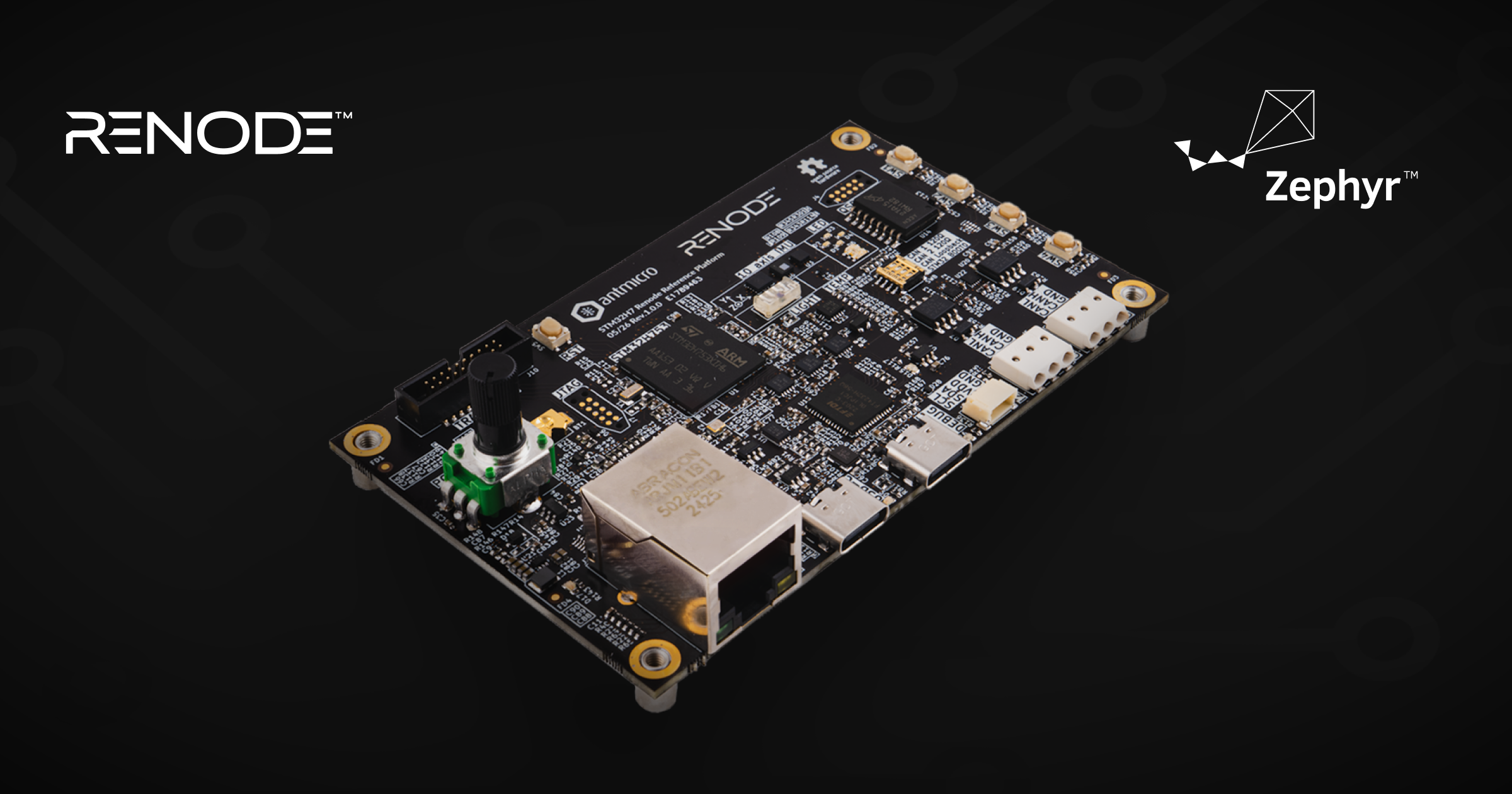
Renode, Antmicro’s open source simulation framework, gives developers of multi-node embedded systems the opportunity to fully own, customize and significantly speed up the development process by simulating components at different levels of abstraction instead of requiring the physical hardware. A virtual hardware setup allows the user to freely experiment with the design, run target software ‘as is’ and build a testing environment for it, long before the physical prototype stage, shifting the software development phase left and providing valuable feedback to hardware design teams. To illustrate just how accurately Renode simulates hardware, earlier this year Antmicro developed the STM32H753 Renode Reference Platform - a Zephyr-enabled physical board accompanied by its digital twin emulated in Renode. Together they make up a complete technology demonstrator that can serve as a platform for learning how to use Renode and how to integrate it into an end-to-end simulation-driven development flow.
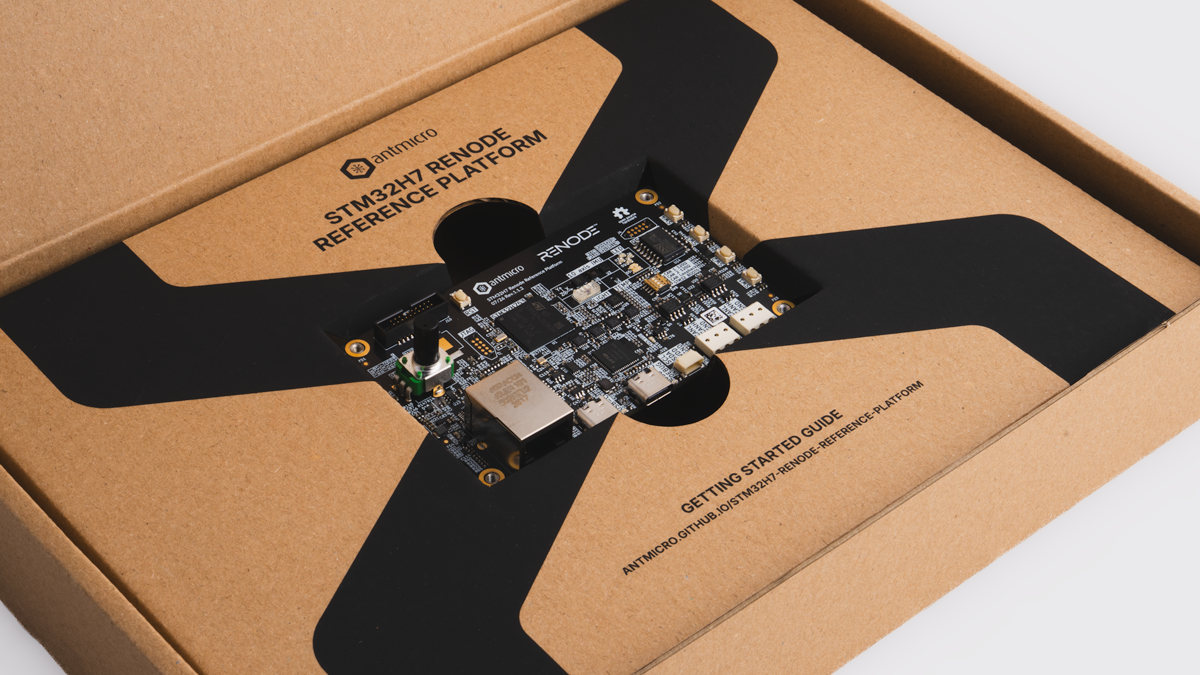
For customers looking to introduce Renode into their workflows hassle-free, Antmicro is now offering a Renode support package, which provides you with an initial 40 hours of hands-on assistance from the Renode engineering team along with the physical STM32H7 Renode Reference Platform. With this support package, now available to order directly from Antmicro’s verks.ai System Designer portal, we can aid you with the early stages of your Renode project like conceptualization or design, help you solve issues, or provide a basic introduction on how to handle the Renode features most important to your team. This article gives an overview of the Renode Reference Platform board and provides insight into how the board’s digital twin can be used to explore Renode’s capabilities.
An evaluation board custom-designed to help get started with Renode
The goal of the STM32H7 Renode Reference Platform design was to provide people with a convenient and simple showcase of the various ways Renode can be used in a typical development process, from conceptualization and design modification, through verification, to debugging and testing. The basis for the platform is an STM32H753 MCU from the widely popular STM32 family, which is strongly supported in Renode, giving the board a base that many engineers are already very familiar with, easing the way into working with it in the virtual setting.
The board is equipped with several sensors for measuring temperature, light intensity, and air pressure, as well as a 10-axis inertial measurement unit for motion and orientation of the device. These sensors can be interacted with in Renode through a virtual environment which provides them with sample values. To achieve repeatable readings, Renode has a dedicated RESD (Renode Sensor Data) format - feeding the sensors data from a RESD file enables testing of sensor drivers behavior by providing coordinated input to multiple sensors in specific moments of virtual time.
The board allows you to interactively debug software using its integrated JTAG bridge - or, for finer control and options that hardware does not allow, you can debug the digital twin from Renode itself. Debugging with Renode using GDB gives the unique advantage of operating within virtual time. With virtual time, the debugging process is non-intrusive, as time perceived by the emulated board does not flow when waiting for user input.
The STM32H7 Renode Reference Platform includes several interfaces, allowing you use it as an element of a complex, multi-node device by connecting to other devices via USB, CAN, or Ethernet. Renode can operate on these interfaces either within the simulation, or by connecting them to a host. For easy inspection of CAN traffic, you can use the new built-in CAN analyzer, which allows you to view bus activity right in Renode’s GUI. And, for testing purposes, you can use dedicated testers for e.g. UART, CAN, and Ethernet from the Robot Framework.
Upgrading development flows with reusable building blocks, co-simulation, and extended testing possibilities
Renode’s features allow its users to leverage unique capabilities that a typical development would not be able to offer. During initial conceptualization and design stages, you can utilize Renode’s plug-and-play building blocks to speed up work and make switching various modules fast and simple. With this, it’s easy to design custom setups, and freely switch modules to experiment with the design of your device.
With the hardware description prepared, you can follow up with developing software for your platform. To run it in Renode, the software requires no changes in code, giving you the chance to test applications for your target hardware platform and observe their behavior exactly as they will behave once you move on to working with the physical setup.
Testing with Renode also has extensive possibilities, enabling fully deterministic testing of complex systems. Testing is not limited to just Renode’s own environment - with its many API layers, Renode has vast co-simulation possibilities. It supports hardware-software co-simulation with physical components, RTL co-simulation with tools such as Verilator, as well as co-simulation with various world-state simulators, which give you the option to test your devices in lifelike scenarios across many industries like space or automotive use cases.
Develop, conceptualize, and troubleshoot with the help of Renode experts
The STM32H7 Renode Reference Platform and its support bundle gives customers a unique chance to discuss and get expert input on development plans, and troubleshoot issues to accelerate your development with direct access and assistance from the creators and maintainers of Renode. The provided 40 hour bundle gives you enough time to learn Renode’s basic functionality, implement it into your workflow, and receive pointers regarding a project you’re working on within Renode. As the support bundle is simply a starting point, we also offer extended support beyond that.
The Renode engineering support package that includes the STM32H7 Renode Reference Platform is now available to order from Antmicro’s verks.ai System Designer portal, with fast and direct shipping to customers within Europe, the USA, Canada, Australia, and Japan.
To get an in-depth look into Renode’s functionality and our services around it, visit our Renode subpage. For any questions regarding the support bundle, visit its Support Terms, or contact us directly at contact@antmicro.com.